

Can Shopify Replace SuiteCommerce for B2B & B2C Business?
WB
WebBee Team
eCommerce Specialists
Every eCommerce business that wants to expand and manage operations efficiently is keen to find an appropriate eCommerce platform that could bring all their chaos to an end. SuiteCommerce is a big name that enterprises usually rely on, as it is known for its advanced functionalities. In this blog, we will explore SuiteCommerce from scratch and see if it can have an alternative because not every seller can afford it. So stick to the blog and find out for yourself.
SuiteCommerce is an eCommerce platform by NetSuite built on cloud technology to offer seamless eCommerce services to online merchants. It is suitable for both B2B and B2C sellers because it offers versatile functionalities that simplify the eCommerce process. Known for its association with NetSuite ERP, it offers advanced features that help optimize end-to-end e-commerce operations comprehensively. Once businesses opt it, they can manage all elements of operations, such as inventory management, order syncing, real-time shipping & delivery tracking, controlling finance, taxation, etc.
Though Evan Goldberg developed NetSuite in 1998, SuiteCommerce emerged only in 2013. It began as NetLedger, an accounting software that utilized cloud technology for the first time; however, it continually upgraded itself and added more functionalities to simplify business operations. In 2003, it was renamed to NetSuite, which reflected its extensive abilities to manage all elements of business operations. Many businesses, including eCommerce, implemented it and improved their operations. Witnessing this popularity, NetSuite developed its own e-commerce store, called SuiteCommerce, in 2013. They created it with the vision of offering a one-stop e-commerce solution to online merchants. The sellers could now create a store with in-built NetSuite ERP functionalities. A year later, in 2014, SuiteCommerce Advanced was launched, which offered greater flexibility and scalability to the sellers. All its products, including SuiteCommerce, were acquired by Oracle Foundation in 2016.
SuiteCommerce has advanced features that help sellers in multiple ways to optimize business performance by enabling smart technology. Let us see SuiteCommerce features in detail:
Sellers do not have to hire a web designer to create their website; rather, they can simply choose from the pre-built themes for the website and create their store in a few hours. You can add a lot of features to it, such as shopping carts, product comparison, a discounted items section, etc.
If a seller deals in B2B e-Commerce and does not want the catalogue to be displayed to all visitors, SuiteCommerce offers the feature of “wholesaler account creation.” Under this, the wholesaler has to create an account before accessing it, as the account has to be first verified by a reviewer.
Want to customize the website after creating it without prior knowledge? Worry not, as SuiteCommerce comes with easy drag-and-drop functionality through which you can add landing pages and enhance current pages with content and images or any other element.
As soon as the customers see a product and think of buying it, easy carting helps them make a fast purchase. SuiteCommerce allows shoppers to add their items to the cart. This functionality helps the buyers make a quick purchase without getting frustrated in a cumbersome process.
SuiteCommerce provides the next level of security with HTTPS support, PCI DSS compliance for seamless real-time credit card processing, and multi-level fraud protection.
Access various reports and monitor operations in real-time with a dashboard that helps merchants make better decisions and strategize their business accordingly.
SuiteCommerce utilizes AI technology to analyze customer data and suggest similar products or any relevant items with the current order. They also personalize the feed based on previous searches, so shoppers can see relatable items and buy them. These techniques help boost sales for sellers, which increases their revenue.
In B2B E-commerce, the buyers usually make the same repeated orders after a certain period. To expedite this process, SuiteCommerce comes with functionalities that make repeated and bulk ordering easier for businesses. This cuts down the time for purchasing the order, and hence orders can be fulfilled faster.
SuiteCommerce provides the feature of MyAccount that grants access to buyers to perform multiple tasks on their own. They can review account balances, return items, or reorder items. They can even send queries directly to the support team, which enhances their experience.
Yes, Suitecommerce is developed with tools and features that are helpful for all types of online merchants. Sellers who have just begun their selling journey may utilize the themes or someone who wishes to sell beyond the borders may opt for multi-currency support, and an established business may leverage all the new technologies. SuiteCommerce has everything for everyone, but the question is - do all sellers need all functionalities, especially when they have to pay a hefty price and require enormous resources to manage the same? Well, certainly not! So, what is the alternative?
Since its inception in 2006, Shopify has emerged as a popular e-commerce platform globally that focuses primarily on B2C e-commerce. It allows sellers to create stores and start selling products without much technical knowledge. However, they need to integrate them with a fulfillment service provider for efficient order fulfillment. It offers scalability for sellers, which makes it suitable for both small retailers and enterprise businesses.
Shopify has multiple benefits that attract e-commerce sellers to choose it. Let us explore these benefits:
Affordability is the key USP of Shopify, which makes it a popular choice among sellers worldwide. Even small retailers can begin their selling journey on Shopify if they are looking for a cost-effective option.
It is easy to utilize and implement as all its functionalities are designed to make the process smooth.
Since it is easy to implement, it does not require additional resources to manage and hence saves costs.
It is easy to integrate applications that sellers want with a Shopify store to optimize their operations.
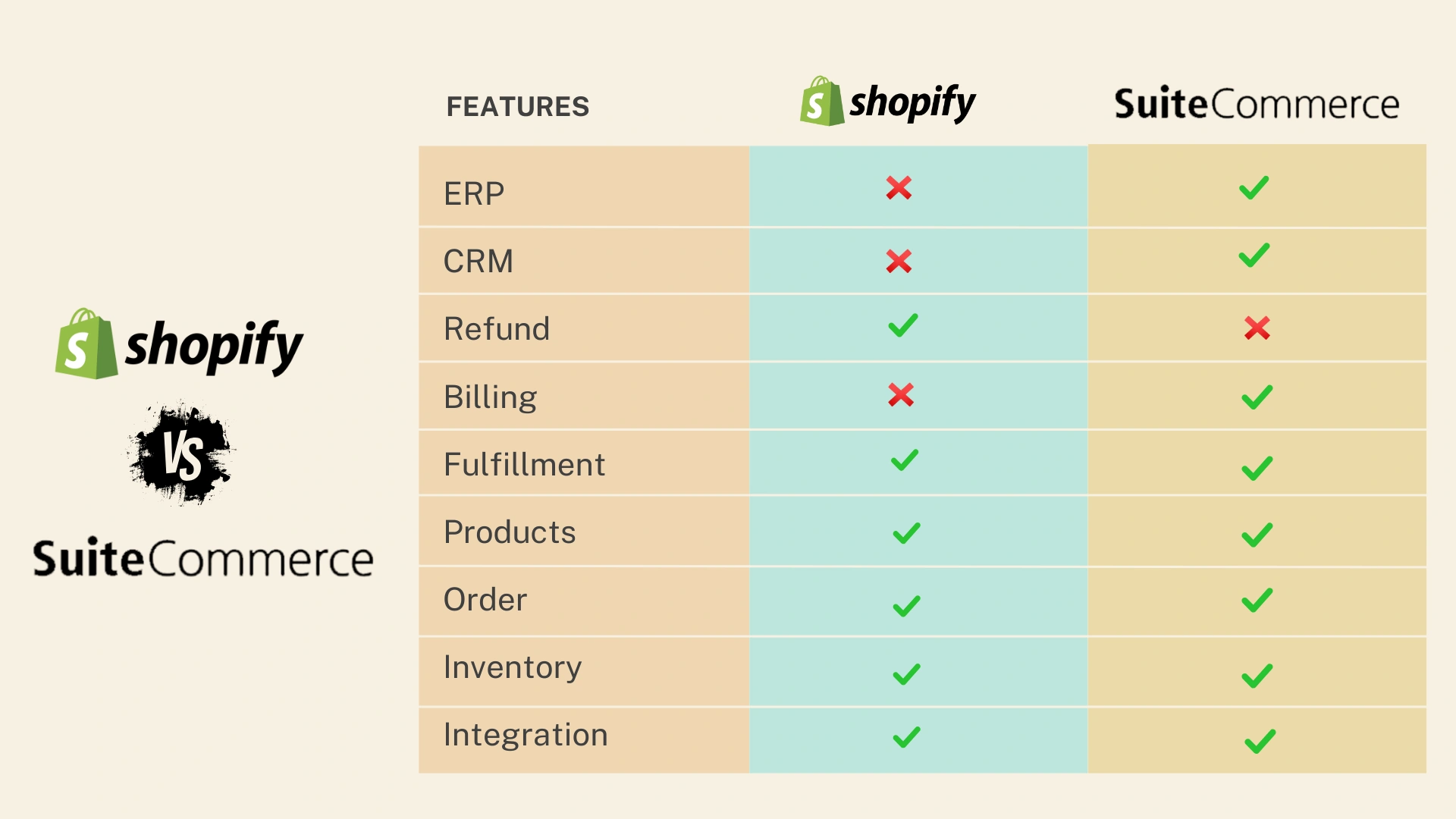
It would be unfair to compare SuiteCommerce and Shopify Store, as both have their pros and cons. Where SuiteCommerce offers holistic e-commerce solutions to the sellers, Shopify is limited to stores and requires an additional ERP or fulfillment service for managing operations and fulfilling orders.
SuiteCommerce is a suitable choice for established organizations and businesses that focus mostly on B2B eCommerce, or the ones that are looking for expansion. In either case, they require end-to-end eCommerce solutions so they do not have to manage operations on their own and are ready to pay a good price.
Shopify is good for sellers who want to utilize its popularity among customers and mostly deal in B2C eCommerce. A better way, which is both economical and efficient, is to opt for a Shopify store and further, integrate it with ERP through a reliable NetSuite connector such as Robust NetSuite Integrator by WebBee. This will help reduce the overall cost, and the sellers can leverage both platforms effectively.

The innovation brought by SuiteCommerce is unmatched in the eCommerce domain. Its advanced functionalities make the operations seamless and streamlined. Shopify is also an established eCommerce platform that continues to simplify its functionalities so all sellers can leverage it for seamless growth. Sellers can utilize any of the platforms based on their business requirements and budget. The future looks innovative and simplified with Shopify NetSuite integration for sellers who opt for Shopify and NetSuite, as both these platforms utilize technology to enhance and simplify functionalities for easier eCommerce operations management.
If you want to discuss more or if you have any queries regarding eCommerce, you may Contact Us.
.svg)